Why AI Content Looks Generic (and How to Make It Sound Like You)
AI content looks generic because the AI only knows what you tell it, so when you give it nothing, it gives you the average of the internet. The fix isn't a better tool. It's better inputs: your real voice, your real stories, and your real photos and video.
I'm Megan Moore, founder of Megan Moore Marketing in Golden, BC. I've spent 15 years in marketing and directed over 100 content captures across Canada, and now I help small businesses set up Claude so their marketing actually sounds like them. The number one thing I hear from owners is the same: "It sounds fine, but it doesn't sound like us." Here's why that happens, and exactly how to fix it.
Why does AI-written content all sound the same?
AI tools learn from huge amounts of writing, then predict the most likely next word. "Most likely" means safe, polished and average. So when you type "write me an Instagram post about our new service," you get the post every other business got too.
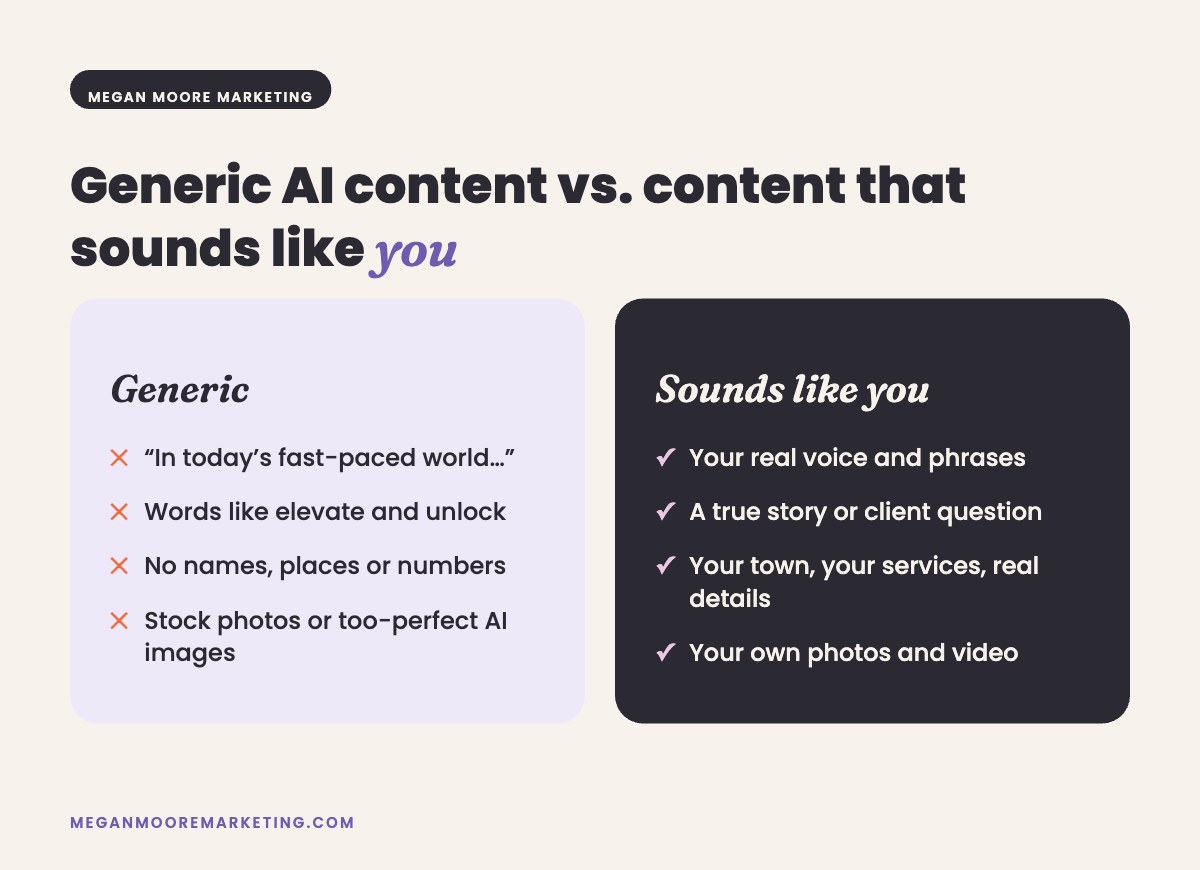
You can usually spot it in a second:
Big, empty openers like "In today's fast-paced world"
Words nobody actually says out loud, like "elevate" and "unlock"
No names, no places, no numbers
Stock photos, or AI images that look a little too perfect
None of that is the tool's fault. It's doing exactly what it was asked to do with what it was given.
What's missing from generic AI content?
Three things only you have:
Your voice. How you actually talk to clients. The words you use, and the ones you'd never use.
Your stories. The client who almost cancelled. The question you get every single week. Why you started.
Your real world. Your space, your team, your hands doing the work.
AI can write. It can't film your treatment room, your shop or your people. That matters more than ever: when everyone can make a polished caption in ten seconds, the real stuff is what stops the scroll.
How do you make AI content sound like you?
You teach it once, then reuse it every time. Here's the simple version I use with Megan Moore Marketing clients.
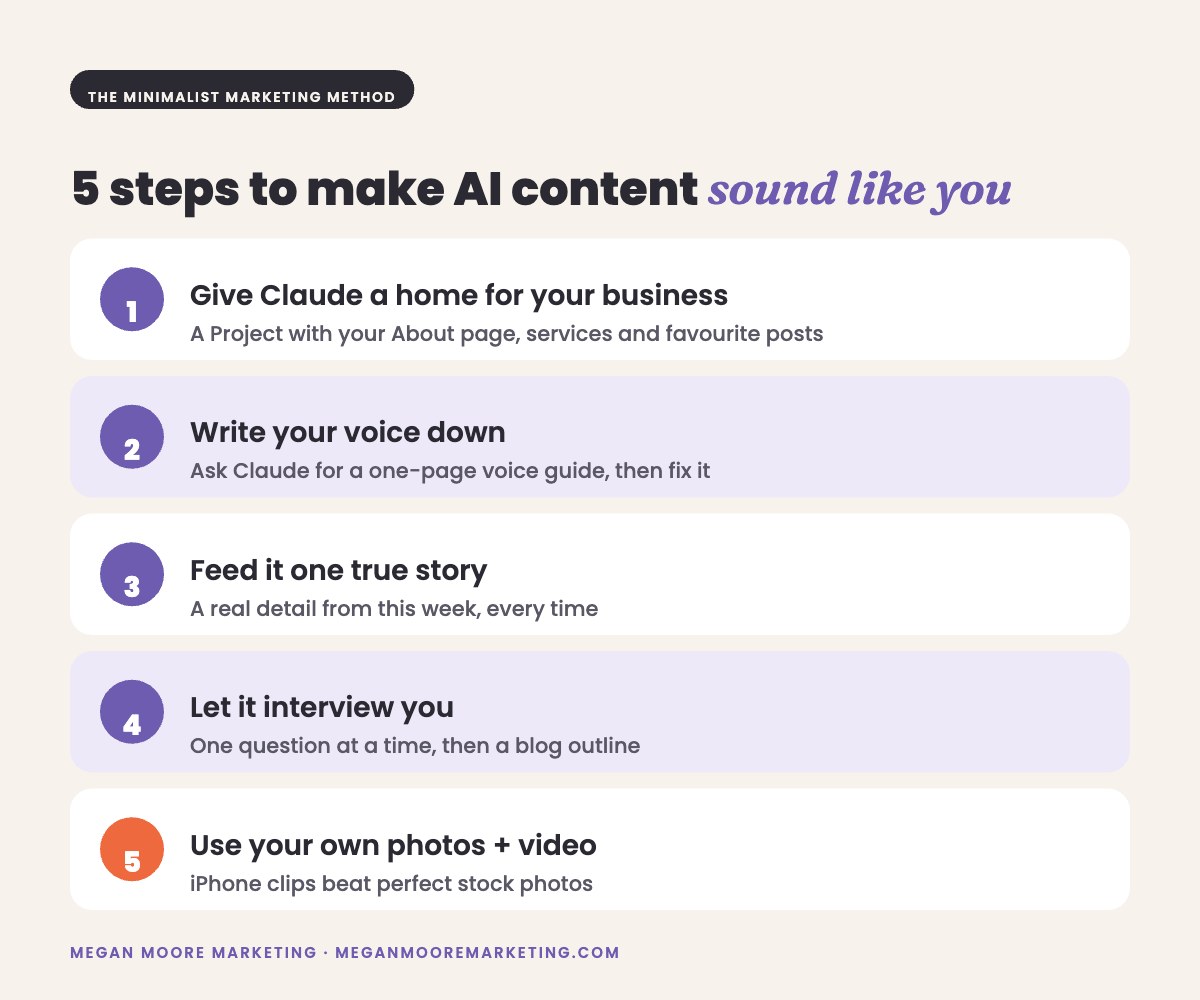
Step 1: Give Claude a home for your business (and keep it tidy)
In Claude, a Project is like a filing cabinet for your business. Every chat inside it can see the files you put there, so Claude starts from you instead of from zero.
Here's the part nobody tells you: a messy Project gives you messy content. If you dump in ten old PDFs, three versions of your price list and a brainstorm from 2022, Claude doesn't know which one is true. It blends them, and you get answers that are a little bit off.
So treat it like a filing cabinet, not a junk drawer. One Project per business. Then a short list of clearly named files, one topic each:
About us (who you are, your story, where you are)
Services and prices (current only)
Who we help (your ideal clients and what they ask you)
Voice guide (Step 2 below)
FAQs (the questions you answer every week)
Best posts and emails (5 to 10 examples you're proud of)
A few rules that keep it clean:
Update, don't duplicate. When your prices change, edit the file. Don't add "prices-NEW-final-v2."
Delete what's not true anymore. Old offers and old team members confuse it.
Name files so a stranger would understand them. "Services and prices 2026" beats "doc 4."
Keep the instructions short. A few lines on who you are and what you want from it is plenty.
When I set up Claude inside a business, this is where most of the time goes. Not the clever prompts. The tidy files. Get this part right and everything after it gets easier.
Step 2: Write down how you actually talk
Your voice isn't a list of nice adjectives like "warm" and "professional." It's how you actually talk. The way you explain things to a client across the counter. The phrases you repeat. The way you start a story. Even the little "mistakes."
That's the part most people try to clean up, and it's the part that makes you sound like you. If you say "okay so" before every story, keep it. If you write in short, choppy sentences, keep them. If you'd never say "elevate your journey," make sure Claude never says it either.
The fastest way to capture it: talk, don't write. Record a voice memo or a quick video answering a few client questions the way you normally would, then paste the transcript into your Project. Then ask Claude:
Read everything in this project, especially my transcript. Write a one-page voice guide for my business based on how I actually talk, not how a marketer would write. Include the phrases I use often, how long my sentences are, my habits and quirks (keep the imperfect ones), words I would never use, and three example sentences that sound exactly like me. Ask me five questions about anything you're unsure of.
Read it back and ask yourself one thing: does this sound like me on a normal Tuesday? Not me on stage, not a brand I admire. Me. Don't pretend to be someone else. People can tell, and the whole point is that they're buying from you.
Fix anything that feels off, then save it as your "Voice guide" file in the Project.
Step 3: Feed it a real story every time
Before you ask for a post, give it one true detail.
Write a short Instagram caption using my voice guide. The story: [one thing that happened this week, with a real detail]. End with one simple question for my followers. No hype words.
Step 4: Let it interview you
This is the best way to get stories out of your head.
Interview me like a journalist about [topic]. Ask one question at a time. When we're done, turn my answers into a blog outline in my own words.
Step 5: Use your own photos and video
Even iPhone clips of your space, your hands and your team beat a perfect stock photo.
Why does real footage matter so much for AI marketing?
Because it's the one thing AI can't fake well, and the one thing people trust.
I've directed over 100 content captures across Canada, in clinics, studios, shops and homes. Every time, the best content came from the same place: the owner talking about why they do what they do, and the little real moments in between.
That's why, when I set up the Minimalist Marketing Method inside a business, it starts with an on-site capture day. In the morning I interview the owner on camera. In the afternoon we film the space, the team and the services. Claude learns their voice from the interview, and the footage feeds their content for months. AI does the writing. Real life does the rest.

Can a small business do this without a big budget?
Yes. You don't need a film crew. Here's a one-hour version you can do this week:
Record a 10-minute voice memo answering: "Why did I start this business, and what do clients always ask me?"
Paste the transcript into your Claude Project and ask for a voice guide (prompt above).
Walk around your space and film ten 5-second clips: hands working, the door opening, the coffee, the details.
Ask Claude for three captions using your voice guide, one for each of three clips.
That's one hour, and the content will sound more like you than anything you've posted in months.
How do I make sure ChatGPT and Google can find my content?
Start with your people, not the algorithm. Before you write anything, get really clear on the problems your audience is sitting with and the exact questions they're typing into ChatGPT or Google late at night.
People don't search for your service name. They search for their problem, in their own words. When your content answers that question clearly, in your voice, you become the answer AI tools can find and share.
Here's what that sounds like for a few kinds of businesses:
A med spa
"Is Botox safe for a first-timer in their 30s?"
"How long does lip filler swelling last?"
"What's the difference between a facial and a chemical peel?"
A spiritual healer or energy worker
"What actually happens in a Reiki session?"
"Why do I feel so drained after being around people?"
"Can breathwork help with anxiety?"
A real estate agent
"Is now a good time to buy a home in a small mountain town?"
"What do I need to fix before I list my house?"
"How much do I really need for a down payment in BC?"
Every one of those is a blog post waiting to be written. Answer one question per post, answer it in the first two sentences, and use the question as your heading.
Not sure what your people are asking? Your inbox and DMs already know. Pull the last 10 questions clients asked you, or ask Claude to help:
Using what you know about my business and who I help, list 20 questions my ideal clients are likely typing into ChatGPT or Google before they book with someone like me. Write them the way a real person would type them, not how a marketer would. Group them by the worry behind the question.
Then keep the rest simple:
Answer the question in your first two sentences
Use headings that match what people actually ask
Include real names, places and details, like your town and your services
Put your name and business name on every post
Generic content has nothing for an AI search tool to point to. Content that answers a real person's real question does.
Frequently asked questions
Is it bad to use AI for my business content?
No. AI is great at the heavy lifting: drafts, captions, turning one blog into a newsletter. It only goes wrong when it's doing the thinking for you. Give it your voice and your stories, and it becomes a fast assistant instead of a generic one.
Can people tell when content is written by AI?
Often, yes, when it's generic. Vague openers, hype words and no real details give it away. Content built on your real stories and photos reads like you, because it is you.
Which AI tool is best for writing in my brand voice?
At Megan Moore Marketing I use Claude, because Projects let you store your voice guide, services and examples in one place so every chat starts from your business. The tool matters less than the inputs, though. Any tool gives generic results with generic prompts.
How long does it take to train AI on my voice?
About an hour to set up a basic voice guide, and a few weeks of small fixes to get it really sounding like you. After that, it gets better every time you correct it and save the change.
Want to see this done live?
In Claude 101 I'll set up a business in Claude from scratch and show you, step by step, how to make posts, a newsletter and a page that actually sound like the business. Then you'll know how to repeat it for yours.
When: Monday, November 9, 2026, 10am Mountain, 90 minutes on Zoom (replay included)
Price: $33 CAD
Taught on: the free version of Claude
In the Rockies? I'm also teaching in person in Golden on Friday, November 6: set up your own marketing agent with Claude.
About the author: Megan Moore is an AI marketing strategist and the founder of Megan Moore Marketing and the Minimalist Marketing Method, based in Golden, British Columbia. With 15 years in marketing and over 100 content captures directed across Canada, she helps women-led small businesses set up Claude so their marketing gets done in their own voice, without it all landing on them. meganmooremarketing.com
Fast systems, slower life,
Megan