Tiny House Living: 7 Real-Life Lessons From 400 Sq Ft (and Why We Added On)
Updated October 2026. I first wrote parts of this in 2023 and 2025. This is the version I wish I'd read before we moved in.
A few years ago, I moved my two kids and myself into a 400 sq ft tiny house in Golden, BC. On purpose.
It was the middle of my divorce and the middle of Covid. I'd never even been inside a tiny home. I'd only watched them on Netflix, for fun, admiring all the clever nooks and crannies. Something just felt right, so I bought one.
Then real life showed up. The kids got older. We added on. And I learned more about life and business in those few hundred square feet than in any bigger house I've lived in.
Here's what tiny house living really looks like, what I'd tell anyone thinking about it, and the small-space tools that make it work for us.
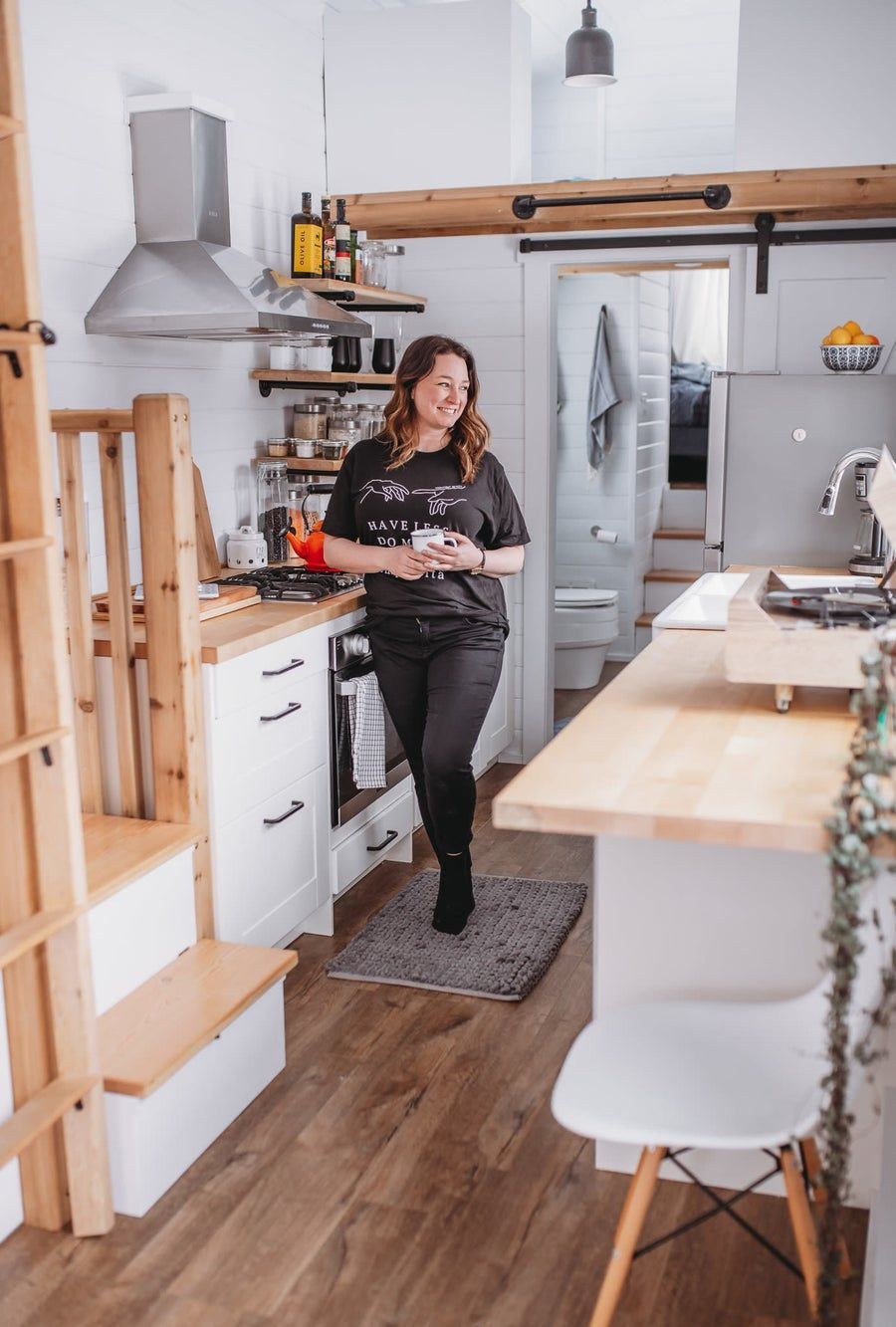
Our tiny house kitchen in Golden, BC. Photo by Amy Katlan, Airdrie, AB.
Netflix tiny house living vs. real tiny house living
On Netflix: every inch is used. Drawers pop out of the floor, a piano takes over the living room, and somehow a record collection fits into every wall. When the show ends, you turn off the TV and walk upstairs to your bonus room.
In real life: your tiny home is delivered and you get a few extra spots in the stairs for pots, pans and toilet paper. That's it. The closet doesn't magically hold 100 dresses, and the dog food has nowhere to go.
But that's part of the fun. Figuring out where things live, based on how often you actually use them, is a skill. And it's the same skill I use in my business every day.
Lesson 1: Make a non-negotiables list (and ignore the rest)
Before we bought, I made a list. It kept me focused on what we actually needed, not what looked cute on TV. Mine was:
Two separate lofts for the kids
A main bedroom for me
A normal-size shower and normal-size sinks
A dishwasher
An angled ladder or stairs to the lofts (vertical ladders are really hard to climb, for adults and kids)
White exterior with black doors and windows
Double doors at the entry, for moving things in and out
Bookcases for storage and loft privacy (each shelf holds six bins of clothes)
A real closet in my bedroom, so I could hang things without feeling like a hobbit

Non-negotiable: a real closet.
I got every single one. I didn't care about the faucet colour or whether every doll had a home. I cared that each of us had our own space.
The business version: before you buy the software, hire the help or start the new platform, write your non-negotiables. Three to five things. Everything else is a nice-to-have.
Lesson 2: Store things by how often you use them
I love my kitchen appliances and didn't want to give them up. So everything I use about twice a month lives in its own clear bin with a lid in the shed: the food processor, the blender, the big soup pot, the vacuum sealer.
Clear matters. With black bins I'd panic and wonder where everything went. With clear ones, I grab what I need in seconds.
When I buy a huge bag of garlic, the vacuum sealer comes in, I seal about three months' worth for the freezer, wash it, and it goes back to the shed. Same with our bulk staples: we cook a lot from scratch, so the freezer and pantry do the heavy lifting.
The tiny house kitchen things we use every week:
Lodge cast iron skillet. We cook in a propane RV oven, and cast iron keeps the heat even.
Ninja Foodi XL Pro Air Fry Oven. We don't have a microwave, so this does a lot of jobs on the counter.
Souper Cubes freezer trays. Bulk cooking, frozen in neat portions that stack flat.
Glass spice jars with labels. We buy spices in bulk and refill these small jars.
The rest of my small-space finds are in my Amazon storefront.
And don't skip the shed. As a tiny house family, the shed is one of the most valuable pieces we own. Everything in it gets used.
Lesson 3: Vision looks wild to people without one
After a few years, we hit a wall. The kids wanted friends over, space to themselves and a place to hang their clothes that wasn't a bin under a bench. Bedrooms with doors weren't a luxury anymore.
When we talked about adding on, people said, "Why not just sell the tiny house?" Some contractors wouldn't even take the job. Then Ollie from North Kiwi Construction showed up and said, "Let's do this."
We already had a kitchen and a bathroom. We just needed room for the kids to stand up, play board games and watch a movie together without sitting on each other.

The addition going on, one dollar, one day at a time.
We added bedrooms, a basement and a second living space. It's still small, but after 400 sq ft, it feels like a mansion. We still have the siding and landscaping to finish, and then the fun stuff: a sauna. One dollar, one day at a time.
You don't owe anyone the blueprint. That goes for your house and your business.
Lesson 4: Growth doesn't mean giving up simplicity
We added square footage, but we kept what tiny living taught us. We still live intentionally. We still keep space for what matters.
Sometimes growth is less about "more" and more about making room for who you're becoming.
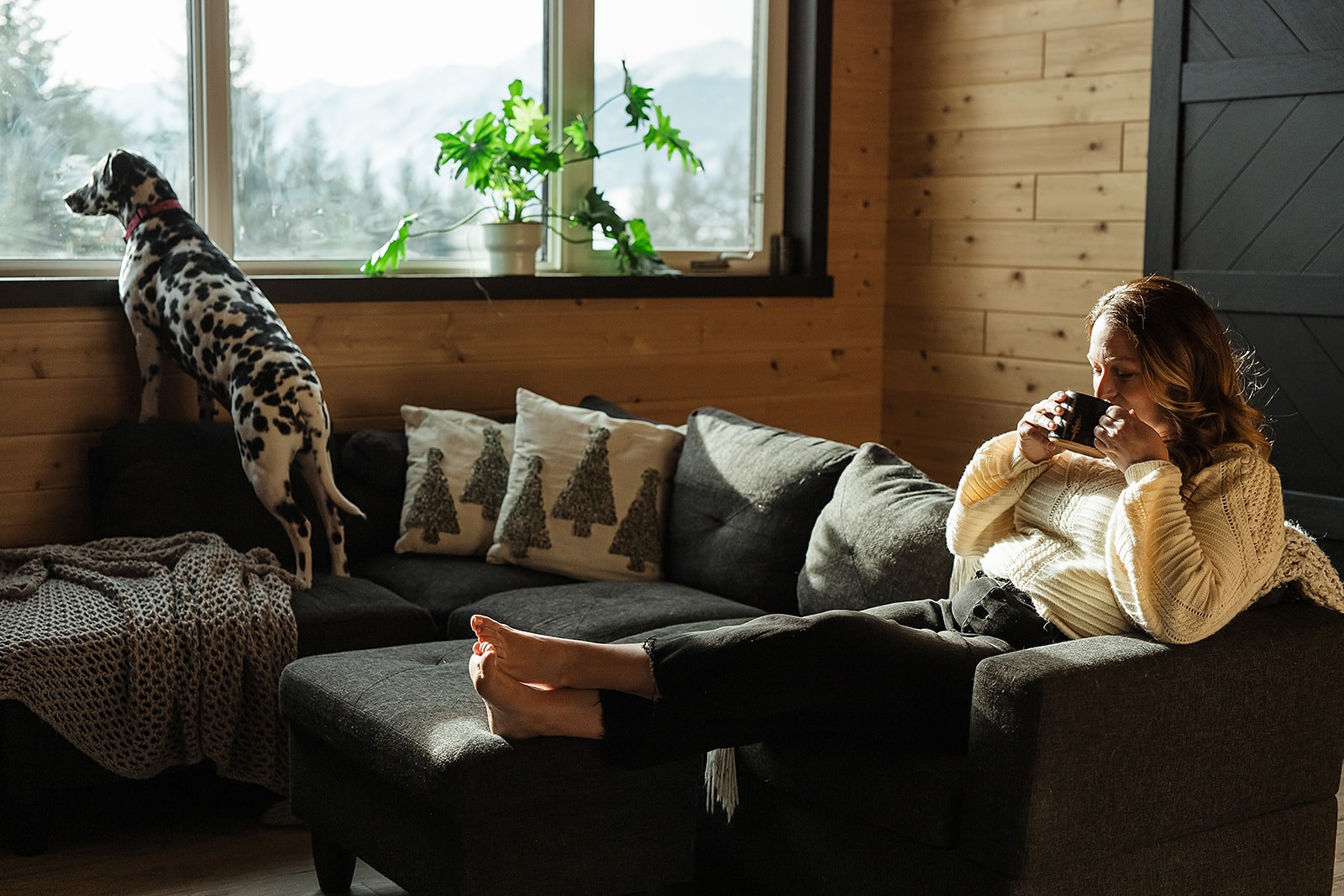
Coffee in the new living space, with Emma on window duty. Photo by Erin Kirkbride.
Lesson 5: Where you work changes how you work
With the addition, I gave up my office in Golden. My old bedroom is now my office, and I look out at the mountains all day. Every morning I post the view in my Instagram stories.
I take breaks in the garden, watch the snow fall and drink my coffee in silence before calls. It brought me back to why I started my business: not hustle, but freedom.
Lesson 6: I didn't want to outsource my whole life
At one point I'd outsourced everything: cleaning, cooking, laundry, errands, even sales calls. I couldn't feel my own life anymore.
Now I want to be in the rhythms of my home. Cook dinner. Clean my space. Feel my days.
Here's the twist: I still outsource. I just outsource the right things. Simple systems and AI tools handle the repetitive marketing work (scheduling, pins, first drafts), so I can be present for the parts of life I don't want to hand off. Fast systems, slower living.
Lesson 7: Freedom doesn't always mean bigger
As entrepreneurs, we're told freedom looks like scaling, a full team and clients in every time zone. For some people it does.
For me, freedom looks like picking my kids up from school, watering the garden mid-morning and doing meaningful work from a home I love.
The tiny house was a reset. The addition was a step forward. You get to define what freedom looks like for you, and then build it one square foot at a time.
Is tiny house living right for you? Questions to ask first
What are your three to five non-negotiables?
Where will the twice-a-month things live? (Shed, storage unit, under the stairs?)
How will this work in three years, as kids, pets or work change?
Where will you work, and is there a door you can close for calls?
What are you willing to let go of, and what are you not?
FAQ: Tiny house living
Is it hard to live in a tiny house with kids?
It's very doable when each person has their own space, even a small loft. Ours worked well for a few years. As the kids got older, they needed doors and more room, so we added on.
How do you store things in a tiny house?
Sort by how often you use things. Daily items stay inside. Monthly items go in clear, labelled bins in a shed or storage area. Bulk food gets vacuum sealed or portioned and frozen.
Can you add on to a tiny house?
Yes, with the right contractor and permits. Some builders will say no. Keep asking until you find someone who sees the vision.
Can you run a business from a tiny house?
Yes. I run my marketing business from home in Golden, BC. The key is a dedicated work spot and simple systems, so your work doesn't take over your living space.
Want your marketing to take up less space too?
I help small business owners set up simple marketing systems: social media, email, Pinterest and AI tools that run in the background, so you can get back to your life.
See my marketing packages · Read my Substack · Message me on WhatsApp
Megan xo
Affiliate disclosure: This post contains Amazon affiliate links. As an Amazon Associate, I earn from qualifying purchases at no extra cost to you. I only share things we use in our own home.